
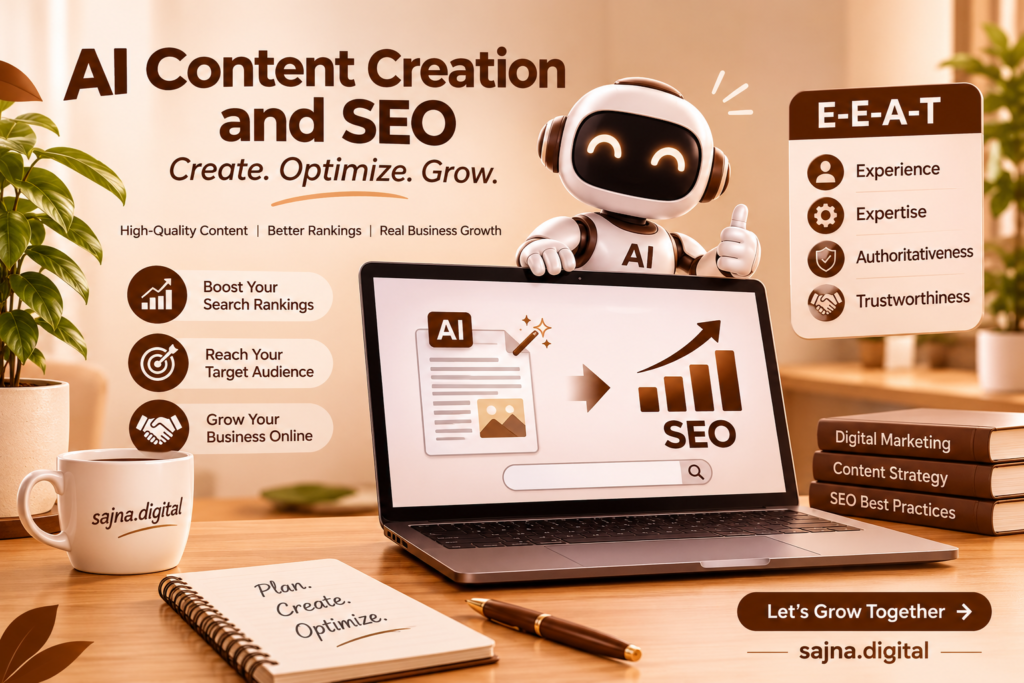
What Search Engines Actually Say About AI Content
Google’s public guidance is simple: it rewards helpful, people-first content, and it does not care whether a human or a tool typed the words. What it does act against is content produced mainly to manipulate rankings, such as mass-generated pages with no original value.
So the question to ask is never “was this written by AI?” It is “is this genuinely useful to the person searching?”
E-E-A-T in Plain Language
E-E-A-T is the framework Google’s quality raters use to judge content. It stands for:
- Experience: Has the writer actually done, used or lived what they describe?
- Expertise: Does the writer have the knowledge or skill to cover the topic properly?
- Authoritativeness: Is the author or website recognised by others as a go-to source?
- Trustworthiness: Is the content accurate, transparent and safe to rely on? Google describes trust as the most important of the four.
E-E-A-T is not a single ranking score you can switch on. It is a lens for the signals that make content credible, and it matters most for topics where bad advice can hurt people, such as health, money and legal matters.
Where AI Helps (and Where It Hurts)
AI is strong at:
- Brainstorming topics and angles
- Grouping keywords by search intent
- Building outlines and content briefs
- Summarising long research and drafting first versions
- Rewriting for clarity, tone or reading level
- Creating meta descriptions, FAQ ideas and schema suggestions
AI is weak at:
- First-hand experience. It has never run a campaign, visited a client or tested a tool
- Current facts. It can state outdated or invented details with total confidence
- Original opinion. It averages what already exists, which is why AI-only articles tend to sound the same
- Local context, such as Kerala or Indian market realities, unless you supply it
The gap between those two lists is exactly where your competitive advantage lives.
A Practical Workflow: AI Draft, Human Authority
Here is the process we recommend for AI-assisted SEO content.
1. Start with search intent, not a tool
Before writing anything, search your target keyword and study the top results. What does the searcher really want: a definition, a comparison, a how-to, a price? Decide the angle first. AI should serve your strategy, not replace it.
2. Use AI for the skeleton
Ask AI for an outline, related questions and a list of subtopics. Then edit it. Remove generic sections and add the ones only you can write.
3. Inject real experience
This is the step that earns the first E in E-E-A-T. Add:
- A real example from a client project or your own testing
- Screenshots, results, before-and-after comparisons
- Mistakes you made and what you learned
- Opinions that might disagree with the common advice
If you cannot add anything from experience to a section, it probably should not be in the article.
4. Fact-check every claim
Treat AI output as a draft from a fast but unreliable intern. Verify statistics, names, dates, tool features and policy statements against primary sources. Link to those sources. Delete anything you cannot confirm.
5. Put a real person behind the page
Trust signals are visible on the page:
- A clear author name with a short bio and credentials
- An About page and easy-to-find contact details
- Published and last-updated dates
- Honest disclosure of how the content was produced, where relevant
6. Edit for voice
Read it aloud. If it sounds like every other article on the topic, rewrite the intro, add a story, and cut filler phrases. A distinct voice is hard to copy and easy for readers to remember.
7. Optimise the technical side
Good content still needs a good foundation: a descriptive title and meta description, a clean heading structure, internal links to related pages, fast load times, mobile-friendly design and relevant structured data.
8. Update and measure
Check rankings, clicks and engagement in Google Search Console after publishing. Refresh posts when facts change. Fresh, maintained content signals care.
Common AI Content Mistakes That Hurt SEO
- Publishing raw output. Unedited drafts are generic and often contain errors.
- Mass-producing thin pages. Hundreds of near-identical location or keyword pages add risk, not rankings.
- Inventing sources. AI can fabricate statistics and quotes. Never publish a number you have not checked.
- Hiding the author. Anonymous content on sensitive topics is hard to trust.
- Ignoring the reader. Keyword-stuffed text written for crawlers fails the people it is meant to serve.
A Quick E-E-A-T Checklist Before You Hit Publish
- Does this page include at least one original insight, example or data point?
- Has every factual claim been verified, with sources linked?
- Is there a named author with a relevant bio?
- Does it answer the search intent better than the current top results?
- Is the date visible, and is the information current?
- Would you be comfortable if a client or competitor read it closely?
If you can answer yes to all six, you are using AI the right way.
AI content creation is a powerful assistant, not a replacement for expertise. The businesses that win in search will be the ones that use AI for speed and humans for substance: real experience, verified facts, a visible author and a clear point of view.
At Sajna Digital, we help businesses build SEO strategies and content that are fast to produce and strong on trust. If you want a content plan that uses AI wisely and builds real authority, we would love to talk.
Ready to grow your visibility? Get in touch with Sajna Digital at sajna.digital for a free consultation.
Not simply for being AI-generated. Content created mainly to manipulate search rankings is the problem, regardless of how it was made. Helpful, accurate, original content can perform well whichever tools were used.
No. It is a framework used to evaluate quality, and many of the signals behind it, such as quality links, accurate content and clear authorship, relate to what ranking systems try to reward.
It is good practice to be transparent where readers would reasonably want to know, and it supports trust. What matters most is that a responsible human reviewed and stands behind the content.
Yes. Big brands have authority, but small businesses have real, local, first-hand stories. AI helps you produce faster. Your experience helps you stand out.